In June 2025, the European Commission launched the European Ocean Pact, a framework for connecting EU ocean-related policy which puts marine knowledge front-and-centre as a cross-cutting foundation and an enabler for delivering EU policy – from Maritime Spatial Planning Directive (MSPD) to the Nature Restoration, including EU Member State commitments to global ocean policy frameworks including the Biodiversity Beyond National Jurisdiction (BBNJ). This follows the EC call for evidence for the…
The EMODnet service is proud to announce that its Data Ingestion service has been integrated into the EMODnet Portal! The migration of this EMODnet component to the Europa domain is a major milestone for EMODnet, with Ingestion joining the seven thematics in the EMODnet one-stop data and services portal. The core functionalities of EMODnet Data Ingestion services remain the same but are now combined and integrated with the other EMODnet services, making it even easier for potential data…
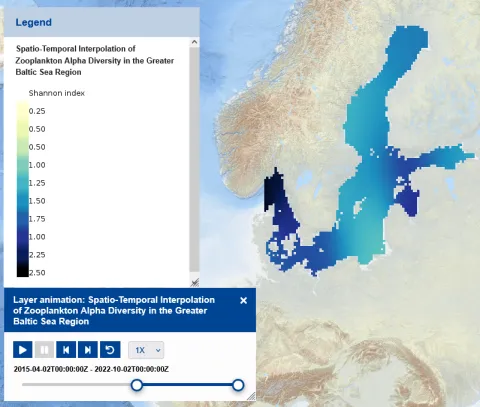
EMODnet Biology’s latest data product, developed by SMHI, offers a spatial-temporal interpolation of zooplankton biodiversity patterns across the greater Baltic Sea area, including the Skagerrak and Kattegat. Based on observed Shannon diversity indices from Swedish and Finnish environmental monitoring data, the product utilizes the DIVAnd (Data-Interpolating Variational Analysis in n-Dimensions) method to generate a three-dimensional interpolation across longitude, latitude, and seasonal time…
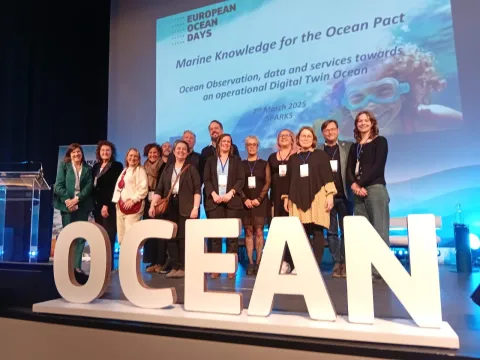
EMODnet was well-represented at European Ocean Days 2025 a high-level, week-long event from 3-7 March 2025 in Brussels that brought together stakeholders from across Europe’s Ocean community. Marine Knowledge was a central theme to the multiple events covering ocean literacy, Mission: Restore our Ocean and Waters, sustainable fisheries, the blue economy, and more. And EMODnet was visible as a key EU asset for marine knowledge at the session “Marine Knowledge for the Ocean Pact”, which included…
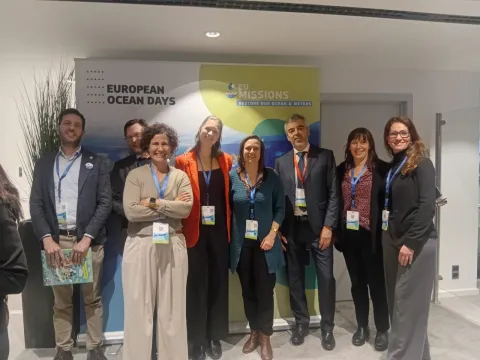
At the Mission Ocean & Waters Forum during EU Ocean Days 2025 in Brussels, the European Digital Twin Ocean (EU DTO) booth drew strong interest from across the marine community. As the in situ component of the EU DTO, and a co-developer of the EDITO-Infra initiative, EMODnet was at the forefront, engaging visitors with insights into how its harmonised marine data underpins the European Digital Twin Ocean and supports dynamic, scenario-based tools for sustainable ocean management.
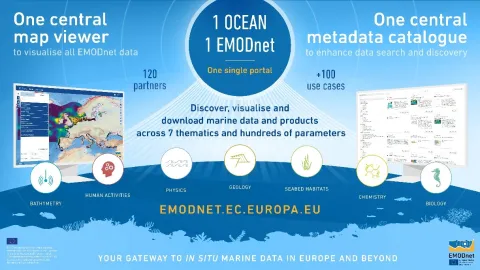
Just over two years ago, in January 2023, EMODnet took a bold step by transforming from seven distinct Thematic Portals—covering Bathymetry, Biology, Chemistry, Geology, Human Activities, Physics, and Seabed Habitats—into a single, unified web portal. Spearheaded by the EMODnet Central Portal Technical Team and thematic coordinators, this transition consolidated marine data access, simplifying user experience and enhancing efficiency.
As a key EU pillar for Marine Knowledge and in situ marine data service of the European Commission (EC), DG MARE, EMODnet welcomes the European Ocean Pact and submitted an EMODnet response to the recent call for evidence which closed on 17 February 2025. The resulting EMODnet response is a collective response by the EMODnet Steering Committee, including the Secretariat, Central Portal and thematic and data ingestion coordinators and SC representatives. EMODnet was also a co-author to a…
The EMODnet Secretariat presented highlights of an EMODnet for ports, marinas and boating sectors workshop at BOOT 2025, the International watersports show in Düsseldorf, Germany. The workshop, co-organised with the European Boating Industry, TransEurope marinas and the European Sea Ports Organisation produced a report in December 2024, with key outcomes presented directly to stakeholders from these Blue Economy sectors as part of the Blue Innovation Dock at BOOT 2025.
Dear EMODnet partners, colleagues and friends, A very Happy New Year to you all! As the Head of the EMODnet Secretariat, it is my pleasure to bring you the EMODnet New Year’s letter, an annual tradition that celebrates the collective achievements of the EMODnet community in 2024 and that looks ahead to EMODnet’s continued evolution and Vision to 2035
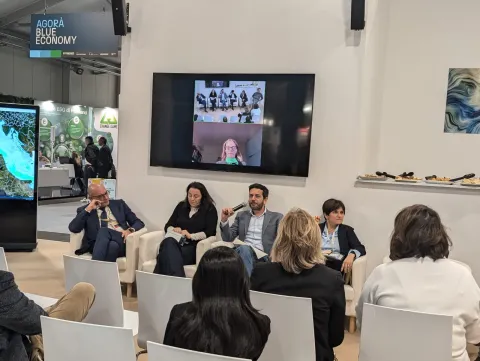
EMODnet Human Activities Coordinator Alessandro Pititto participated in a roundtable on Innovations in Coastal Monitoring and Forecasting for early warning systems that took place in Rimini, Italy on 6 November, part of a series of events organized by the Decade Collaborative Centre for Coastal Resilience during the Ecomondo green technology expo event. EMODnet offers a diverse range of coastal data, from marine environmental to human activities data.