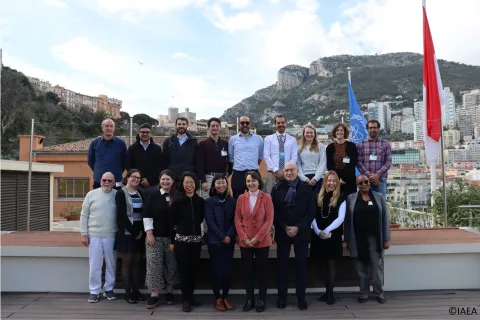
From 11 to 13 March 2025, the National Institute of Oceanography and Applied Geophysics-OGS, which coordinates EMODnet Chemistry, was in Monaco to represent the consortium at the workshop on Harmonization of Monitoring and Assessment of Plastic Pollution of the Global Partnership on Plastic Pollution and Marine Litter (GPML) Community of Practise (CoP). At the meeting, participants faced the challenging task of considering and bringing together different communities concerned with plastics in…
In February 2025, Athanasia (Sissy) Iona, Head of the Hellenic National Oceanographic Data Centre and EMODnet Data Ingestion Scientific Coordinator presented the pollutant maps in the EMODnet Map Viewer to the EMODnet Chemistry Board of experts on the EU Marine Strategy Framework Directive (MSFD). She highlighted the recent improvements and new visualisations. EMODnet Chemistry has been interacting with stakeholders involved in the Regional Seas Conventions and the MSFD since its launch in 2009…
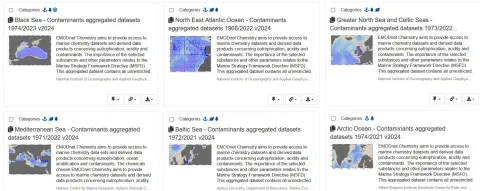
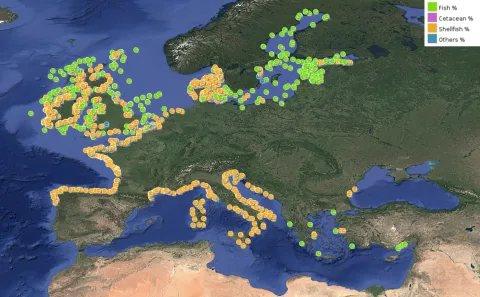
In addition to the 25 maps published in 2023, new and updated maps for contaminants in water, biota and sediment have recently been made available in the EMODnet Map Viewer.
Just over two years ago, in January 2023, EMODnet took a bold step by transforming from seven distinct Thematic Portals—covering Bathymetry, Biology, Chemistry, Geology, Human Activities, Physics, and Seabed Habitats—into a single, unified web portal. Spearheaded by the EMODnet Central Portal Technical Team and thematic coordinators, this transition consolidated marine data access, simplifying user experience and enhancing efficiency.
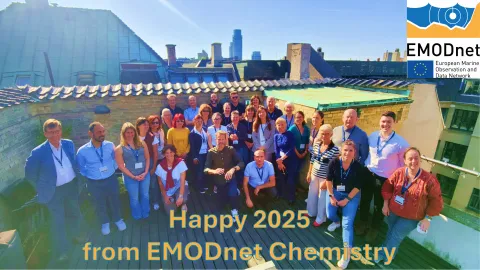
Each EMODnet thematic is underpinned by an expert network as part of the wider EMOD-network. The EMODnet Chemistry Partnership celebrates its 15th birthday with the entire EMODnet community by summarising its 2024 highlights. EMODnet Chemistry was launched in 2009 and has been working for 15 years to put the FAIR data principles into practice. Over the years, technologies have changed, old methods have given way to new ones, but core partners have remained and have included more and more data…
Dear EMODnet partners, colleagues and friends, A very Happy New Year to you all! As the Head of the EMODnet Secretariat, it is my pleasure to bring you the EMODnet New Year’s letter, an annual tradition that celebrates the collective achievements of the EMODnet community in 2024 and that looks ahead to EMODnet’s continued evolution and Vision to 2035
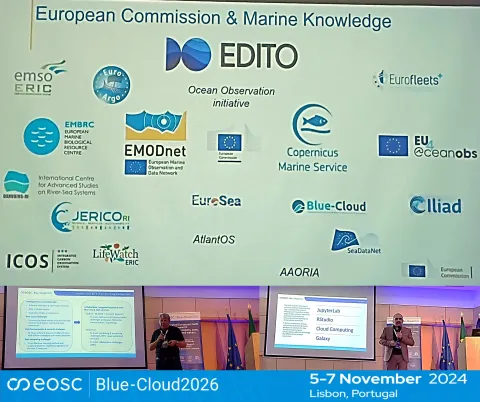
How does EMODnet Chemistry contribute to the Blue-Cloud 2026 project and vice versa? To answer this question and better illustrate the synergies between EMODnet and this key European project, , the Institute of Oceanography and Applied Geophysics – OGS, which is Coordinator of EMODnet Chemistry and in Blue-Cloud 2026, took part in the three working days on Blue Cloud 2026 in Lisbon (Portugal) from 5 to 7 November. EMODnet Physics, Data Ingestion and the Secretariat also participated.
How can we increase accessibility to land-sea interface data near river mouths? This was the focus of the meeting chaired by EMODnet and +ATLANTIC CoLAB in Lisbon on 8 November. Portugal was chosen as the venue because the Portuguese Environment Agency is a leader in providing river outflow data to EMODnet. One of EMODnet's most important national oceanographic data centres, the Hydrographic Institute of Portugal, is also located there. EMODnet plays a key role in supporting the…
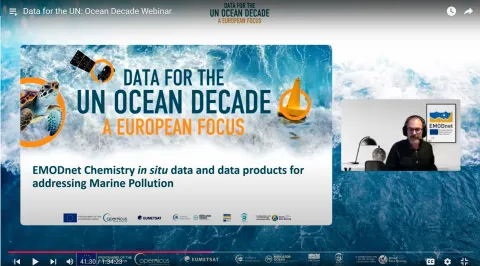
On 10 October 2024, EMODnet, Copernicus Marine Service and EUMETSAT delivered the second webinar in the EU Ocean Data Series bringing together experts – including early career ocean professionals - to explore how Earth observation, in situ, and modelled marine data support the UN Ocean Decade initiative.
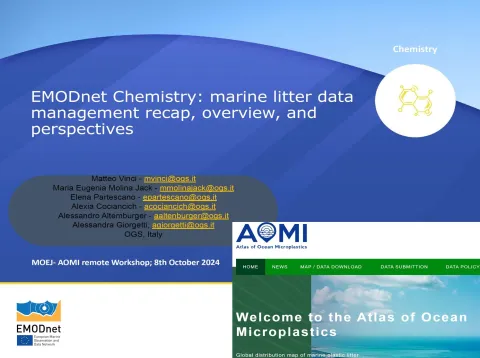
At the international workshop titled AOMI Database: Enhancing Ocean Microplastics Monitoring, EMODnet Chemistry showcased how marine litter data are managed within the project. Held on October 8 and led by Japan’s Ministry of the Environment, the workshop provided a practical demonstration of the Atlas of Ocean Microplastics (AOMI).